You get what you pay for.

Colorado AR-15 Shooters Club Discussion Forums
Welcome to the Colorado AR-15 Shooters Club Discussion Forums.
Welcome to the Colorado AR-15 Shooters Club Discussion Forums.


You get what you pay for.

Talk to Mick Boy. He is selling some great gear for pretty decent prices.

To Echo what Molon Labe said; You get what you pay for.
For most people there is definitely a point of diminishing returns when buying armor carriers. The average guy just won't spend enough time wearing it to justify a Crye AVS or something similar. But I guarantee if you by some rubish nylon and do anything in it more than walk around the house, you'll wish you had bought something with a little better quality.
Regarding plate placement: This was posted by Panzerr over on Lightfighter. It's an excellent explanation of where your plates should sit and why.
Purpose
Body armor is meant to keep you in the fight. That is, armor is meant to protect your vital organs which, if hit, would immediately take you down and prevent you from putting rounds on target. The possibility of saving your life is a secondary benefit of body armor.
What to protect
With this purpose in mind we must understand those structures we need to protect which we can realistically protect while still maintaining a high degree of mobility. Our primary concern is the heart and the large blood vessels which sprout from the top of the heart: the superior vena cava, the arch of the aorta and the pulmonary trunk. I will refer to these vessels simple as “related vessels” from here on. A hit to the heart and its immediately related vessels will very quickly take you out of the fight and kill you within a minute or two.
Second in importance to the heart is the respiratory diaphragm, the muscle which, when contracting, allows you to decrease air pressure within your lungs and thus take in air. Destroy the diaphragm and you destroy one’s ability to breath.
Protecting the vertebral column goes without saying -we wish to protect as much of this as possible without sacrificing mobility for obvious reasons.
It is important to note that a hit to the lungs may prove to eventually be lethal but is not nearly as lethal as quickly as a hit to the heart and its immediately related blood vessels. The liver and kidneys, while highly vascular, are also not immediately incapacitating.
Front/chest plate
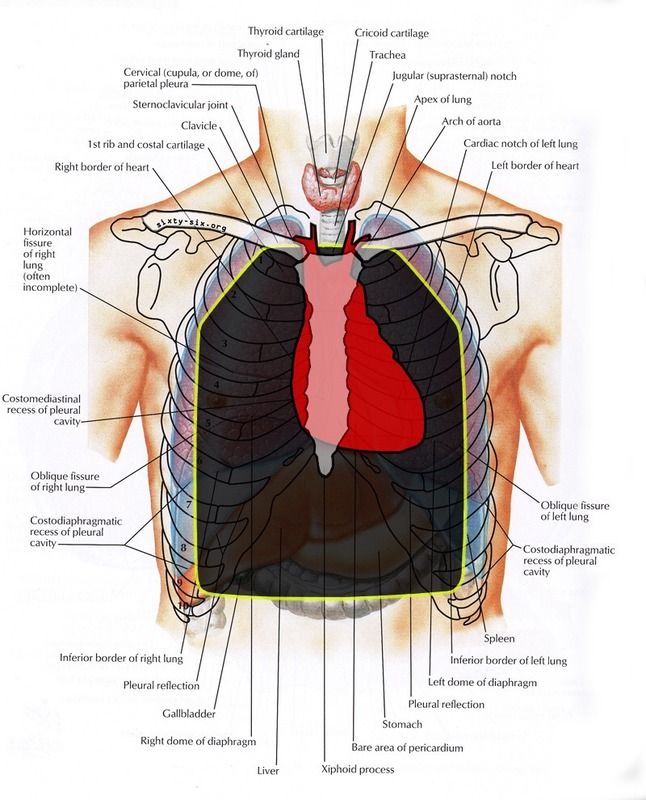
The top of your plate should be at the level of your suprasternal notch aka jugular notch. If you follow your sternum towards your head, the soft spot you reach at the top of it is the suprasternal notch. Your plate should ride at least level with the top of your sternum while standing.
The importance of positioning the plate at the top of the SN Notch is that you have a bundle of large blood vessels which rest on top of your heart and lie behind the manubrium (the uppermost portion of your sternum), most notably the aortic arch. The aortic arch receives blood from your left ventricle and will have the highest velocity of all the blood in you systemic circulatory system. Get hit here and you will be done. So, make sure your plate is riding higher, rather than lower because protecting your aortic arch is much more important than protecting your guts.
Also, as you can clearly see with the image below, a smaller plate allows for more comfort and mobility to the shooter will not necessarily mean you will leave immediately incapacitating areas unprotected -large plates will only cover a little more of your peripheral lung tissue and guts.
Reference image (anterior view)
Red is your heart and related blood vessels
Dark Grey/Yellow is a properly positioned plate
The sternum and clavicle are white with black outline
Positioning of rear/back plate
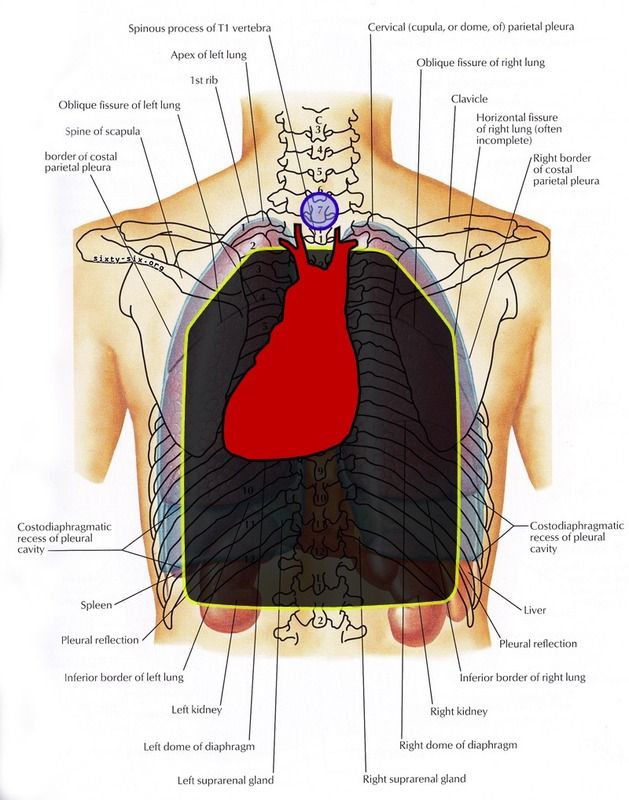
Find the most prominent bony eminence at the base of your neck. This is your vertebral eminence. Count down two bony spinouses (or measure down about an inch) and that should be above the level of the superior aspect of your sternum. Positioning at least this high will ensure your entire heart and its immediately related blood vessels are protected.
Reference image (posterior view)
The vertebral eminence is marked in the diagram below in blue.
Side plates and shoulder plates
Side plates are intended to protect the highly vascular elements of your abdomen. Side plates were introduced to prevent troops from bleeding out in the chopper on the way to the field hospital. Side plates are not necessarily intended to protect the heart, but if you wear them high up into your armpits you can protect some of the lower portion of your heart.
Protecting your heart from a shot to side is accomplished by shoulder plates, such as the ones manufactured by Crye Precision.
To sum it up
Here are general guidelines to follow at a bare minimum. As always, the more protection you can have without sacrificing mobility the better. This is just the bare bones.
Front plate: should be even with top of the sternum while standing, extend at least 1.5 inches past the bottom of your sternum and should cover the entirety of your nipples
Rear plate: should lie no lower than an inch below your vertebral prominence
Side plates: the higher they ride the better
Mick-Boy
"Men who carry rifles for a living do not seek reward outside the guild. The most cherished gift...is a nod from his peers."
nsrconsulting.net
Here's a very cool looking PC from Chase Tactical.
Sent from my SM-G920T using Tapatalk

I tried a few today at Life and Liberty.
Shellback Banshee
Warrior assault DCS
Perroz design
I'm a fat guy and I run a belt so I want it to as minimal as possible. The perroz was by far the most comfortable! I liked how I can add the attachment for three extra mags with two clips and Velcro.
Now for a civilian what plates should one go with??
"An armed society is a polite society when a man may have to back his last words with gunplay."
My Feedback

I like my mayflower apc it's nice cause it clips into my d3cr chest rig wish it had the velcro on it but whatever. Really comfortable even fully loaded. Need to buy a battle belt to go with it.
"Amat Victoria Curam"- victory loves preparation
Feedback https://www.ar-15.co/threads/50597-l...ghlight=lex137

The wife and I went with the shellback banshee and ar500 plates. The banshee is super nice and is really adjustable. The plates are heavy but priced right.
Don't be stupid!!!!!
I found the shellback's cummerbund wasn't long enough for me at stock configuration. Yes I'm fat!!
I guess I could get longer shock or pararcord and extend the cummerbund. I'll have to give them a try again tomorrow. I think I will invest in a good carrier and AR500 plates now and upgrade later
"An armed society is a polite society when a man may have to back his last words with gunplay."
My Feedback
I always had the buy once cry once frame of mind when it comes to buying things, not saying you need the most expensive fancy pc/plates. I'd just rather pay a little more for what I want and not buy again later, good luck either way still trying to decide on plates steal/ ceramic or soft armor...
"Amat Victoria Curam"- victory loves preparation
Feedback https://www.ar-15.co/threads/50597-l...ghlight=lex137
Some relevant info in this thread - https://www.ar-15.co/threads/60522-S...-Plate-carrier
Regarding Hard plates: Thin, light and inexpensive. You get to pick two.
My boy Eggroll just posted this yesterday in a discussion on FB.
Ceramic plates work by dissipating incoming projectile KE, with a soft armor backing that distributes the energy over a larger surface area. The result is localized disruption of the plate material which will vary due to hit location, projectile type and incoming angle of fire. Because of this disruption, the hit location will provide degraded or nonexistent protection.
Ceramic plates are also encased in a thin wrap of spectra or KEVLAR fabric to act as an anti Spall lining for ceramic chip mitigation.
Materials include but are not limited to Boron carbide and alumina oxide resulting in per plate weights pushing 9 lbs per
Due to the ceramic nature of this material, drop impacts upon corners or edge oblique will have detrimental effect on plate structure. In short, don't Joe your shit
Steel, yeah, everyone thinks it's the Thor breastplate. While strong, and could be formed into thinner form factors than issue or standard composition ceramics, the risk of frag spalling is much higher. But use of this material is a presumed risk vs mission parameters.
UHMWPE plastic plates... yeah the magical mystical lightweight plate. It's a compositionally heavier form of milk jug plastic. Thermally more sensitive to the environment. Thus cannot be stored or expected to work reliably in environments exceeding 120F. Advantages... yeah lightweight, but it's still polyethylene and will not stop the range of rifle threat out there when compared against steel or ceramic.
Hybrids... much too doo has been made of these Hybrid armors that use Poly and ceramic. Performance appears to be better than Straight poly armor, but long term performance and opinions have yet to be promulgated to the community as to whether this will be a viable Avenue to pursue
In short, do your homework.
Swimmer cuts are named so to better illustrate the geometry for better range of motion at expense of coverage
SAPI profile is government issue form factor, and if your carrier is made for x-sized plate, then it will fit your plate
OEM profile cuts. Some vendors will offer plates cuts in proprietary form, like Velocity and their ULV steel plates
Make sure you get carriers that match your plate size and geometry
Mick-Boy
"Men who carry rifles for a living do not seek reward outside the guild. The most cherished gift...is a nod from his peers."
nsrconsulting.net
 Posting Permissions

 Reply With Quote