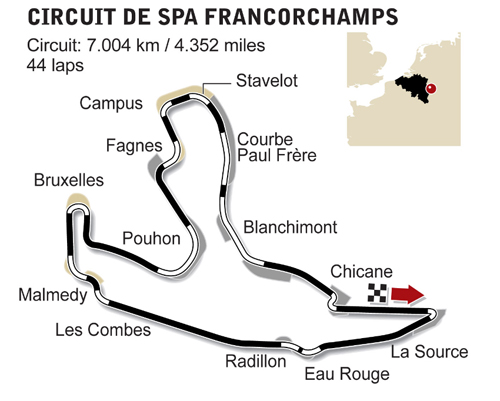
Not as much as Monza, "older" Hockenheim, GilleVillnue Circuit, and spa francorchamps. (of course, Albert park , and Monaco, if you consider those a circuit).
Not a fan of Hermann Tilke designed or modified (face lifted) Circuits.
Not as much as Monza, "older" Hockenheim, GilleVillnue Circuit, and spa francorchamps. (of course, Albert park , and Monaco, if you consider those a circuit).
Not a fan of Hermann Tilke designed or modified (face lifted) Circuits.
That first turn at Francochamps is dangerous if you are going flat out.
![]()
Well, Herman Tilke's track is known to be boring. (see wiki article at the end)
He is well known circuit designers for newer F1 circuits, but F1 cars are so aerodynamic grip heavy to overtake on Herman Tilke's circuit. It might be a good circuit for Leman, or GP or NASCAR circuit (closed wheel) cars.
His circuit creates too much dirty air for cars behind them to overtake on a high speed corners.
Good part about Herman Tilke's circuit is that he uses lots of elevations. Lots of uphill and downhill at a critical areas. However, less forgiving than other exciting circuit.
His circuit really made F1 even more boring when F1 was using grooved tires between 1999 to around 2005 (less mechanical grip, and more depend on aerodynamic grip)
From WIKI
Tilke's track designs have been the subject of criticism. A 2009 profile in The Guardian noted that Tilke "has been accused of penning boring tracks and, even worse, of butchering legendary ones like Hockenheim."[1] Former driver and team owner Sir Jackie Stewart was critical of Tilke in a 2011 piece in The Daily Telegraph, blaming his designs for the lack of overtaking and excitement at many Formula One races, saying they "are largely carbon copies of each other". Stewart, while praising the vast improvement the designs have brought to the sport's safety as well as "bringing fantastic amenities and luxuries to the sport", argued that the tracks have "gone too far the other way" in terms of safety. His primary complaint was that the large tarmac run-off areas fail to "penalise mistakes"; he cited the 2010 Abu Dhabi Grand Prix, where Mark Webber was unable to pass Fernando Alonso, despite the latter running wide on four occasions, because the track's run-off areas did not impede him. Stewart suggested that the run-offs be made of a substance that slowed the cars down and thus punished drivers' mistakes.[2] Webber echoed Stewart's views, stating that he was "spot on".[3][4]
I have four laps on the ring from back in 2004 games do no do it justice ran an 11 something in a Ford Focus.
They should host a half marathon on that track.
"There are no finger prints under water."